Future activities of The Dorset Grove

And Of The Crow Feather a Druid Group within the Dorset Grove


What is a Druid

A Druid is a member of an ancient Celtic religion that covered the role of priest, scholar and judge for the Celtic people. The Celts lived in Britain, and Western Europe until around the 5th Century, A.D., by which time most had either disappeared or had been converted to Christianity. Typically, a Druid oversaw religious activities, performed rituals, and also acted as a tribal historian by preserving the histories of the Druid’s tribe through stories and oral tradition. Also assuming the role of judge, a Druid would advise the leaders of the tribe on political matters, make laws and settle disputes.

The religion practiced by the Druids was simply known as Druidism and was polytheistic, meaning that many gods were worshiped rather than just one. These gods could either be elemental, representing fire, for example, or be associated with a particular human action or trade such as metallurgy or fishing. A Druid typically practiced the art of divination, which is an attempt to predict the future through physical events, and believed that the human soul would live on through a new human body upon death. There were no written sets of religious beliefs for a Druid since this figure relied solely on oral tradition for passing on information through generations.


Druidry is one of the most popular pagan religions because of its reverence for the land, but it isn't all robes and standing stones. Druidry is a spiritual path that takes a combination of hard work, respect for the land and a sense of style...

What is modern Druidry?

First, what is druidry not? Druidry is not Wicca. It doesn't have any great connection to witchcraft either. Modern Druidry is also not a recreation of the practices performed by the ancient Druids. Modern Druidry certainly draws inspiration from that source, but we know so little about the ancient Druids that recreating their ways is nigh-on impossible.

Now that we have that out of the way, we can begin to discuss what Druidry really is.

Well, Druidry is often described as a religion, and in some cases this is certainly true, but to simply pigeonhole it as "another religion" is doing it a disservice. Modern Druidry is a philosophy, community position, a learned art and above all else a way of life.

Following the spiritual path of the Druid is a way to gain a keener insight into the world around you, while at the same time serving the land and your community. The Druidic path focuses on your responsilities - you have to serve the land, revere it, earn from it and give back to it.

What do Druids do?

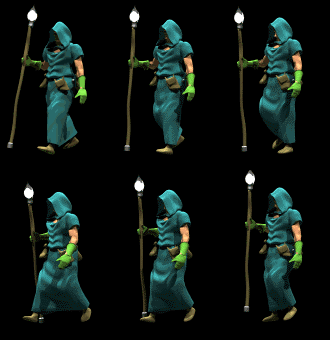
A common image of a Druid is that of a robed man, standing in some place like Stonehenge, performing some kind of eldritch ritual. In some regards this isn't too far from the truth. Druids do actually use Stonehenge and other similar places in modern rituals to acknowledge certain solar events like Solstices.

But that really is just the smallest piece of the pie.

As well as performing priestly functions, Druids are trained to be artists, storytellers, community advisors and teachers. Through their ways, Druids seek to gain an inherent understanding of reality, which may be expressed through the natural world, mythology and connecting to the divine.

Druidry is also a green path. Druids are like custodians of nature and the land in which they live, learning its lessons and keeping it maintained, like an ever-watchful spiritual gardener.

This respect for the land goes well beyond a simple appreciation of landscape. It is also a respect for the land's local spirits and Gods. The Druids understand the concept of community. They recognise they live alongside the spirit world and that those local spirits are our neighbours.

We are all one in nature.

What do Druids believe?

Although Druids have a defined outlook and philosophical approach to life, there is no central concept of the divine to which all Druids adhere. So that means that there are no set "Gods of Druidry" and no singular manner in which to worship the divine. Some Druids don't concern themselves with Gods at all.

Druids often fit themselves into their local pantheon of Gods and spirits, so a British Druid could worship ancient Celtic deities, while an American Druid may honour the divine in the form of the local Native American concept. Alternatively, each individual Druid may simply align themselves with which ever pantheon of Gods they feel the most comfortable with.

A reverence of the ancient European (particularly Celtic) Gods is probably most common in Druidry.

However, most Druids believe in the following things:

  • Life itself has a spiritual nature about it.
  • Nature is sacred.
  • There is more than just the world we see. There also exists a spiritual world around us that we go to when we die, but we may also visit this place for a time in dreams, trances, meditations and other altered states of consciousness.
  • Rebirth. The Druid concept of reincarnation holds that the soul may be reborn life after life, and that we exist in the spiritual world between lives.
  • The truth of reality is hidden behind our perceptions and can be revealed through study and insight.


Every thought is a whispered prayer